

Wrist pain from holding your toddler — Parent Injury Recovery Guide is one of those postpartum surprises nobody really warns you about. Motherhood is completely wild. People make it sound poetic and dreamy—like you’re supposed to stare at your newborn and hear lullaby music while cherubs float overhead—and yeah, sure, sometimes you get those moments. Sometimes you really do look at your baby and think, holy crap, this is incredible.
But there’s this whole other part that no one advertises honestly, which is: your body can get absolutely demolished. Pregnancy does one type of destruction. Birth is a separate demolition. Then postpartum hits, and now you’re hauling around this tiny floppy human whose entire existence depends on your arms, and meanwhile your joints are like, “hey buddy, we’re actually dying.”
And in that list of postpartum body nonsense, there’s this extremely common hand and wrist thing that almost nobody warns parents about. You start holding a baby for weeks or months, doing the same little grip over and over, and suddenly there’s this sharp pain that flares every time you lift them. A ton of new mums end up with what people casually call “mother’s wrist.” Some call it mother’s thumb. Some people have heard of De Quervain’s tenosynovitis—which sounds like a horrible villain name but is literally just irritated tendons.
Whatever label you slap on it, it sucks. It’s basically your wrist tendons getting fed up because you’re doing the same motion five hundred times a day while running on fumes and coffee.
And new parents, especially mums, are expected to just… deal with it. “Power through.” “Don’t complain.” “Just embrace motherhood.” So a lot of women ignore it until the pain is bad enough that holding a coffee cup—or worse, holding your baby—feels like torture.
Causes of Mother’s Wrist
Let’s strip the fancy medical talk away and say it plainly: you overuse your wrist. That’s the whole story. Repetitive movement injury. You lift the baby. You set the baby down. You pick up the baby again fifty seconds later because they’ve decided floor time is disrespectful. You carry them on one hip. You grab the stroller. You lug diaper bags that weigh as much as a Thanksgiving turkey. You wrestle with the godforsaken five-point harness in the car seat.
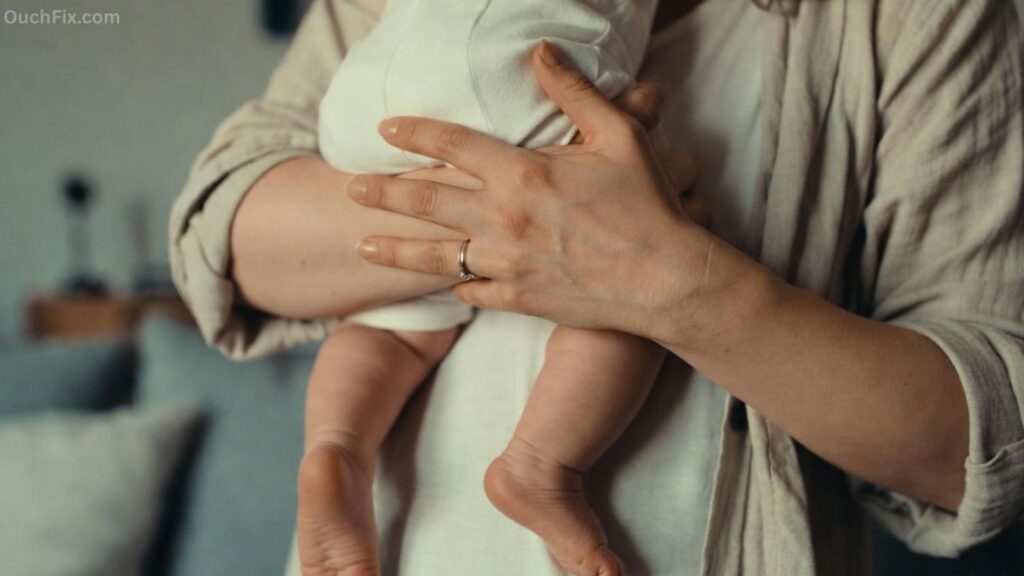
And every time you do that, you’re using the same tendons. They get irritated, swollen, pissed off. They start gliding in weird directions. Stuff rubs. Things get inflamed. Nothing dramatic—just chronic annoyance building up until your body finally throws a tantrum.
And the funny part is you’re not “training” or doing something athletic. You’re not swinging kettlebells or rock climbing. You’re literally just parenting. But babies require this weird grip-and-pinch motion with your thumb that most adults don’t use constantly. Suddenly your thumb is the star of the show, and eventually that tendon is like, please stop gripping me like a lobster claw.
This is why it’s super common in new mums. Also in grandparents who babysit a lot. And fathers. And honestly, in anyone who works physically or does repetitive lifting. But new mums get hit especially hard because:
- They’re sleep-deprived
- They’re constantly holding a small wiggly human
- They’re feeding, lifting, soothing, bouncing
- Their posture is wrecked from breastfeeding and bending forward
- They get zero recovery time
Basically, it’s the perfect storm for tendon irritation.
Also Read: Neck Pain From Looking Down at Your Phone in Bed — Fast Fix + Prevention
Symptoms of Mother’s Wrist
Symptoms vary like crazy. Some people barely notice it—it’s just a little twinge when twisting a jar lid. Others get hit so hard they can’t hold a saucepan without wincing.
Common things you might feel:
- Pain on the thumb side of your wrist (a sharp, stabbing kind of annoyance)
- Visible swelling
- Stiffness, like your wrist forgot how to bend
- Weaker grip strength—you drop stuff, or avoid lifting anything heavy
Sometimes the pain spreads upward into the forearm. Sometimes your thumb feels sore, tight, or just useless. Sometimes you get weird tingles and think, awesome, now half my hand is numb—love that journey for me.
And the worst part is, it interferes with tiny dumb everyday things. Stuff that shouldn’t hurt:
- Picking up your kid
- Pouring a kettle
- Holding a phone
- Typing on a laptop
- Opening jars
- Brushing hair
- Twisting a doorknob
- Pushing yourself up from the couch
That’s usually the moment parents panic: why does everything hurt now?
And since babies don’t schedule their own care—you can’t say, “hang on, I’m resting my wrist today”—it gets worse shockingly fast.
Treatment Options for Mother’s Wrist
The good news: you’re not permanently broken.
The bad news: you might have to change how you do stuff, which is deeply annoying.

Here’s what helps.
Rest
I know—hilarious. “Rest.” With a newborn. Sure. But honestly any small decrease in aggravating wrist movements helps. Even micro-rests.
Try:
- Stop lifting with your thumb jammed under their armpit
- Stop scooping the baby like a claw machine
- Ask someone else to carry the car seat
- Alternate arms instead of using the same side all day
You won’t get a spa retreat, but maybe you stop doing the most harmful motion ten times a day.
Ice
Ice is boring but effective. Inflammation is part of the whole problem. Toss an ice pack on there for 10–15 minutes a couple times a day. Doesn’t have to be fancy. Frozen peas were invented for injuries.
A Wrist Brace or Splint
Braces are legit lifesavers. They force your wrist to stay neutral—meaning it can’t fold into that painful angle that triggers the tendon. Some people only wear them in the day. Some only at night. Some wear them constantly for a week.
Whatever works. The brace is not a sign of weakness—it’s a sign you’re trying not to destroy yourself.
Physiotherapy
A physio will look at how you lift your baby, how your wrist moves, what tiny muscles are weak, what’s tight, and how your posture contributes. They might give you stretches, strengthening drills, or ergonomic advice that isn’t “just try harder.”
And a big part of wrist pain is actually coming from shoulders and upper back exhaustion. If you’re rounded forward all the time, your wrists end up compensating.
A physio can literally show you baby-lifting techniques that won’t torch your hands.
Hand Therapy
Even more specialized. Hand therapists understand all the tiny tendons that hate you. They can tell you which one is angry and what to do about it. They give you custom exercises that look too simple to matter, but somehow they work.
Pelvic Floor Physio (stay with me)
This seems random—because who thinks “my wrist hurts, better check my pelvic floor”? But postpartum bodies are like a row of dominoes. Once one thing collapses, other joints start doing weird compensating. Pelvic floor therapists look at breathing, alignment, internal pressure, posture—all the stuff that trickles down (or up) to your wrists.
Postpartum bodies are connected in ridiculous ways. Everything influences everything.
Medication
Sometimes inflammation needs help. A doctor might prescribe something stronger, or you can use over-the-counter stuff like ibuprofen (if safe for you). You’re not “weak” for using pain relief. You’re injured. Athletes take medication for injuries. Parents are allowed to, too.
Diagnosing Mother’s Wrist
If your wrist has hurt for weeks and you’re hoping it magically self-destructs into dust and floats away—go see someone. A doctor or physio will poke around your wrist, bend your thumb in a couple of painful directions, and usually they can diagnose it right there.

If they want to rule out other things—like a fracture or arthritis—they might order an X-ray or MRI. But most of the time they don’t need imaging. They’ve seen so many cases it’s basically déjà vu.
The important part: don’t wait forever.
This injury can turn chronic if you ignore it. Chronic meaning:
- Long-term tendon irritation
- Nerve irritation
- Ongoing weakness
- Pain that takes months to unwind
Why suffer when you’re already juggling sleep deprivation, baby feeds, emotional chaos, and the general identity crisis of postpartum life?
Preventing Mother’s Wrist
Prevention sounds boring, but if you don’t want to re-injure yourself endlessly, it matters. Prevention is basically “stop doing the thing that keeps breaking you.”
Some simple stuff:
- Lift babies using the whole forearm, not just a thumb grip
- Keep your wrist straight when lifting
- Bend with your knees, not your spine like a retreating shrimp
- Take micro-breaks if your hand feels tight
- Stretch your wrist occasionally
- Use a pillow for feeding support so your arm isn’t holding the full baby weight
Switch sides sometimes. Even if the baby “prefers one side.” Your baby doesn’t care about your tendons. They are not paying your medical bills.
This isn’t perfection. Just less repetitive strain.
Also Read: What Wellness Practices can help Alleviate Tension Headaches?
Mother’s Wrist Exercises
These look pathetically basic. They might not feel like a workout. But tendons love boring stuff. Small, consistent movements work.

1. Wrist Stretch
- Arm straight
- Palm facing down
- Pull fingers back gently toward you
- Hold 15–30 seconds
- Repeat 5 times
Do not yank it like you’re trying to rip your hand off. Just a stretch.
2. Grip Strength
Grab a stress ball or squishy toy.
- Squeeze for 5–10 seconds
- Release
- 15 reps each hand
If your hand screams, back off. This builds gradually.
3. Wrist Circles
- Extend your arm out
- Palm down
- Circle slowly 15 times clockwise
- Then 15 counterclockwise
Warms up the area without strain.
4. Finger Extensions
This looks dumb, but it helps undo all the gripping.
- Arm out
- Spread fingers wide for 5–10 seconds
- Close them together for 5–10 seconds
- Repeat 10–15 times
It counterbalances all the pinching your thumb does all day.
CONCLUSION
So yeah—mother’s wrist is just a thing. It’s not glamorous. It’s annoying. You don’t magically heal by doing nothing. Your tendons are not superheroes. If you keep lifting a baby like a claw machine at an arcade, your wrist is going to keep yelling at you.
Rest if you can. Ice if you remember. Wear a brace if you don’t hate the feeling. Ask for help even though motherhood culture acts like you have eighteen arms and infinite stamina.
Get treatment early so you don’t end up with lifelong wrist pain. Stretch sometimes. Stop letting your thumb do all the heavy labor. Complain loudly—because honestly it sucks.
And hopefully your wrist stops being rude and you can pick up your kid without feeling like your arm is exploding. That’s the goal.
FAQs About Mother’s Wrist
Q1. Is “mother’s wrist” a real medical thing or just something mums complain about?
Ans: Yeah, it’s real. The medical name is De Quervain’s tenosynovitis, which basically means the tendons around your thumb are irritated from overuse. So no—you’re not imagining it, and you’re not dramatic. It’s an injury.
Q2. Why does holding my baby even cause wrist pain? They’re tiny.
Ans: Tiny, yes—but you’re lifting them constantly. You’re gripping, pinching, scooping, supporting their head, holding bottles, carrying diaper bags, wrestling car seats… it adds up. It’s like doing the same micro-exercise 400 times a day with no rest.
Q3. How long does mother’s wrist last?
Ans: Depends on how fast you stop irritating it. Some people feel relief in a couple of weeks with rest and a wrist brace. If you completely ignore it and keep overusing the tendon, it can drag on for months. Worst-case, it becomes chronic and way harder to fix.
Q4. Do I actually need a wrist brace or is that overkill?
Ans: Honestly? Braces help a ton. It keeps your wrist from bending into the painful angle, which gives the tendon a break. You’re not signing up for lifelong brace-wearing—just enough time to calm the area down.
Q5. Do I have to stop holding my baby?
Ans: No one is taking your baby away. You just need to change how you hold them—more forearm support, less thumb gripping. Also: swap arms sometimes. Your dominant side is getting wrecked.